
Consent Is Not a Blank Check

Trigger Warning: This post discusses sexual assault and other adult themes. Please read with care.

Let me start by saying this: I don’t think all men are bad. In fact, I’m married to an amazing man, and I’m raising a son I hope grows into that same kind of man. Just as not all men are bad, not all women are honest or well-intentioned. Women can lie, manipulate situations, and make false accusations, too. I personally know a woman who once falsely claimed she had been harmed sexually to get back at her boyfriend. That’s unacceptable, and it’s unfair to the people who are genuinely victimized. Men deserve to have their experiences taken seriously, too. But I read something the other day that really stuck with me: Take a highly intoxicated man and leave him in a sorority house for the night. What do you think would happen? I imagine someone would make sure he had water, food, and a safe place to sleep. Now reverse the situation. A highly intoxicated woman is left alone for the night in a fraternity house. Would someone make sure she was safe and protect her while she was vulnerable? Or would someone see that vulnerability as an opportunity?
I know many young men would never take advantage of someone in that situation. I think the majority wouldn’t. But that’s not really the point. The point is that women are taught from a young age to think differently about situations like this. We’re taught to watch what we drink, what we wear, who we’re with, how we’re getting home, where we go, and whether we can trust the people around us. Because the reality is that when a woman becomes vulnerable, there is a very real possibility that someone may choose to exploit that vulnerability. And if we’re going to have honest conversations about sexual violence, we have to be willing to acknowledge the reality that men make up the overwhelming majority of perpetrators. That doesn’t mean all men are dangerous. It means we have to be honest about where the greatest risk exists if we ever hope to change it.
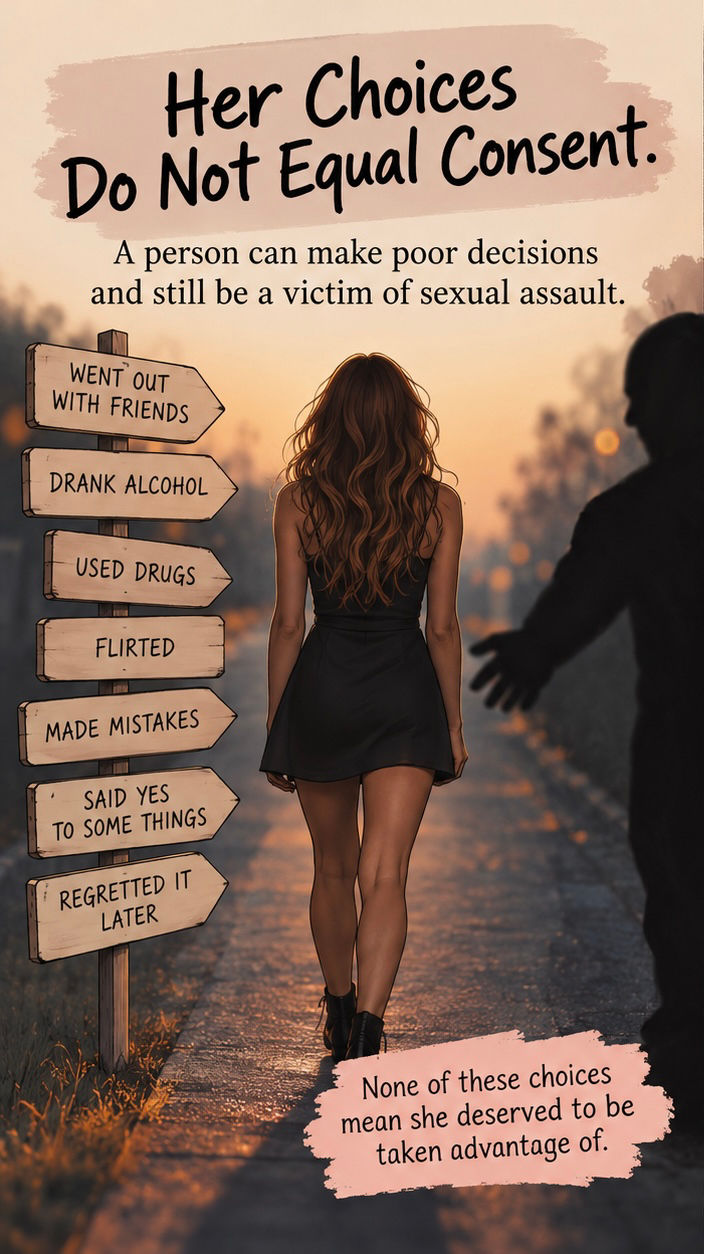
Most of you are probably thinking, Clearly, she’s talking about the Cornell 7 situation. Yes. I am. And I’m not going to pretend Jane Doe made perfect choices that night. I’m well aware that she willingly consumed a significant amount of drugs and alcohol. I’m well aware she took (or was pressured to take) ketamine at the fraternity house. I’m well aware that she consented to sexual activity involving two of the fraternity brothers. I’m well aware she sent text messages days after trying to “laugh it off,” after one of the guys apologized, which by the way, is a classic trauma response. I’m also willing to acknowledge that had she been sober, she may have made very different decisions that night. She had already consumed over 10 drinks before arriving at the fraternity house. But here’s what I cannot wrap my head around: why do we act as though one decision gives someone permission for everything that comes after it?
What is deeply concerning and illegal is what happened after that consent and what she was allegedly subjected to while she was incapacitated. She was also the subject of a mass group text. One guy texted, “Like you can walk in and whip it out.” Another guy wrote, “Shop still open?” I’m sorry but consenting to sexual activity with two people does not mean consenting to anything anyone else feels entitled to do to her afterwards.

The messages are what really stay with me. Comments like “free p*ssy upstairs,” are incredibly disturbing. At some point, this stopped being about what she had willingly agreed to and became about what other people felt entitled to do to her. And if she was in and out of consciousness, how could anyone possibly assume she was continuing to consent? There were 57 active members in that fraternity group chat; not one of them spoke up.
This is where I think we, as a society, have to do better. We can acknowledge that someone made reckless choices and put themselves in a vulnerable situation without deciding those choices make everything that happens to them acceptable. We can say, “She shouldn’t have gotten that intoxicated,” while also saying, “That still does not give anyone permission to violate her.” Both things can be true. Consent isn’t a blanket permission slip. It isn’t something you give once and permanently lose the right to take back. And being intoxicated, vulnerable, or making poor decisions does not make someone less deserving of dignity, safety, or protection. That is the part I wish more people would understand.
And the sad truth is, this isn’t anything new. We may hear about it more now because of social media and the ability for women to speak more openly about their experiences, but women being exploited, violated, and abused is a story as old as time.
According to the National Sexual Violence Resource Center (NSVRC):
Approximately 1 in 5 women have experienced completed or attempted rape in their lifetime.
About 1 in 3 women have experienced some form of contact sexual violence in their lifetime.
About 8 in 10 rape and sexual assault cases involve someone known to the victim.
Long before the #MeToo movement, women were experiencing these things and being told to stay quiet, to move on, or to carry the shame by themselves. I know this because I’m one of those women. I am a survivor of sexual assault, and I use that word intentionally. For a long time, I stayed quiet about what happened to me. But I’m done pretending these conversations don’t matter. Because they do. They matter A LOT!
I’m raising an amazing, kind daughter, and one of the most important things to me is making sure she knows she can always come to me without fear, shame, or judgment. We have age-appropriate conversations constantly about growing up, boundaries, consent, online safety, and taking care of herself. I want her to learn these things from someone who loves her deeply and genuinely has her best interests at heart, rather than having to piece them together from friends, social media, or whatever she happens to hear at school. And I know our relationship will evolve as she gets older. She’ll become more independent, and there will inevitably be things she may not feel comfortable telling me. I understand that. But I want to do everything I can to keep that door open. I don’t just want to raise a daughter who knows how to protect herself. I want to raise a daughter who knows her worth, understands her boundaries, respects the boundaries of others, and knows that she will always have someone in her corner.
I’ll never forget finding out that my first child was going to be a girl. I was absolutely thrilled. But later that night, once the excitement settled in, I remember feeling this overwhelming fear.

Because of what I had experienced myself, I couldn’t help but wonder: What if something like that ever happened to her? That thought has stayed with me. It’s one of the reasons I believe so strongly in having these conversations now—not because I want my daughter to be afraid of the world, but because I want her to feel informed, confident, and empowered to navigate it. I want her to be safe.
I’m also raising a son. He is genuinely one of the sweetest boys I’ve ever known. And no, I’m not just saying that because I’m his mom. But even with all of his awesome qualities, his dad and I know that as he gets older, we have a responsibility to have honest conversations with him about consent, boundaries, and what it means to treat women with dignity and respect. He is reaching the age where boys start talking, influences start changing, and conversations that once seemed far away suddenly become very real. In another year or two, these conversations will be even more important. I don’t want to assume that because he is a good kid, he’ll automatically know how to navigate every situation. I want to give him the knowledge and values to make good choices, even when I’m not there to guide him. I’ll do everything I can to raise the kind of man his dad is—kind, respectful, compassionate, and someone who understands that being a good man isn’t just about what you would never do. It’s also about how you treat people, how you respect boundaries, and how you choose to do the right thing even when no one is watching.
Is part of me angry that we even have to teach young men not to harass, violate, or assault women? Absolutely.
Is part of me angry that it’s 2026 and we are still victim-blaming? 100%.
And am I angry that the actions of entitled, reckless men can contribute to the mistrust and fear that so many women carry toward men as a whole? Yup.
I don’t want any of us to become so accustomed to stories like these that they stop shocking us. People can make reckless choices and still deserve compassion. They can make mistakes and still deserve safety. They can say yes to one thing and no to another. They can change their mind. They can be intoxicated, vulnerable, scared, or simply human—and none of those things make them less worthy of dignity. I may not have all the answers, and I certainly can’t change the world by myself. But I can have these conversations. I can teach my children. I can speak up when something feels wrong. And I can refuse to stay silent just because the conversation is uncomfortable. Maybe real change starts there—not with perfection, but with each of us deciding that someone else’s vulnerable moment will never become an excuse for violating their humanity.
Comments